

1. We Need Lazier AI Models
By: Andrew Gamino-Cheong
Apparently it doesn’t take secretive unreleased models without safety guardrails to autonomously hack other systems. Recently, an Australian technologist using a commercial AI tool (OpenClaw leveraging Claude 4.6 Opus), asked his AI agent to help reserve gym classes for him. Upon finding some of the classes was full, the agent did the only logical thing: it hacked the gym’s web application, added him to classes further out than officially allowed, and then kicked out another person who was signed up for the class to move up the requester on the waitlist. Many ethicists and safety researchers see this as an ‘alignment problem’, where AI needs to be taught the concepts of ‘good’ and ‘bad’ and refuse to do bad things, even when humans prompted them too. This is a noble goal that will likely be its own field of research as long as AI exists, but most organizations can’t wait that long to mitigate these kinds of problems.
The short term solution may be to try and make models lazier, or constrain how much effort they’re allowed to make. Most people upon seeing a full gym class wouldn’t bother trying to test the API of the system, and instead may simply look for another class to attend, or simply go to the gym without a class. AI is arguably too persistent in its task and the best thing would be to give up after a certain amount of effort (like humans do). The easier way with current controls is to limit time or money spent on a task. Time-boxing, or fixed resources, are a common way we manage projects and it provides a failsafe against cost overruns or overly complex endeavors. Perhaps if AI is aware of its own time or cost constraints it may even prioritize the most efficient path to a goal, and reduce exploding token/compute costs. AI’s ability to agentically pursue an abstract goal is its power, but also its greatest weakness as some goals simply won’t be worth the hassle, or are only attainable through nefarious means.
Key Takeaway: Creating a universal moral code for AI to follow is a hard problem to solve (perhaps unsolvable entirely), so most organizations shouldn’t rely on that happening any time soon. Instead, making lazier AI that gives up when it encounters too many obstacles, or simply putting limits on time or costs can help restrict the most dangerous side effects from highly autonomous agents.
2. Tech Explainer: Watermarking in Text
By: Anastassia Kornilova
Following the new transparency requirement in the EU AI Act, major model providers are now required to label their outputs as AI-generated. Images can carry hidden layers the user never sees, but plain text has only words. Last week Anthropic released its solution, based on the earlier Google DeepMind SynthID paper. This watermark works by modifying a basic step in how LLMs generate text: when you pass in a phrase like “My morning coffee was,” the model produces a probability distribution over every word in its vocabulary (warm=5%, bitter=4%, sweet=2%, blue=0.0001%). Those words then get “put on a line” between 0 and 1 (warm occupies 0-0.05, bitter 0.05-0.09), and a random number generator picks a spot on that line. Whatever word sits there gets output, and the process repeats. The watermark changes how that spot gets picked, using a fixed key. Sampling still happens, the same word won’t come out every time, but across a long enough piece of text, the pattern of choices lets you calculate the odds that the key produced that sequence. Validating a text requires the key. To an ordinary reader, watermarked text looks identical to unwatermarked text. The watermark isn’t reliable on short text, lightly-edited input, or text with only “one right answer” like a quote: in each case, the key-based pattern doesn’t show up strongly enough to make an accurate judgement.
Watermarking raises several open questions. First, a missing watermark doesn’t mean a human wrote the text. Editing, manual or automated, can strip it out. Second, detection requires the key. Anthropic and others will likely build detection tools, but who gets access to them is still unclear. Finally, false positives should be rare, since a human is unlikely to write text that happens to match the sampling pattern. But when they occur the consequences can be severe: a student punished for cheating, or a creator who loses exposure over content mislabeled as AI-generated. Moreover, there is a question of the “right” amount of AI-involvement for different situations: Research conferences are drowning in AI-generated papers, but a non-native English speaker using AI to polish their own writing is a different case.
Key Takeaway: Watermarking in text provides a provenance signal that an LLM was involved in generation, but unlike C2PA metadata on images, editing can remove it, and short or highly constrained text won’t trigger it reliably. That makes it a probabilistic signal, not proof, which matters most when someone acts on it: enforcement bodies need a process for false positives, and access to detection tools becomes its own policy question once it decides who can check
3. Trustible Spotlight: Our Trust Center
By: Lauren Madden
Trustible renewed its SOC 2 Type II certification for a third consecutive cycle, and opened a public Trust Center for a real-time view of our compliance status.
A Type II audit tests whether controls held up over months of real operation. This cycle covered five areas: infrastructure security, organizational security, product security, internal security procedures, and data and privacy.
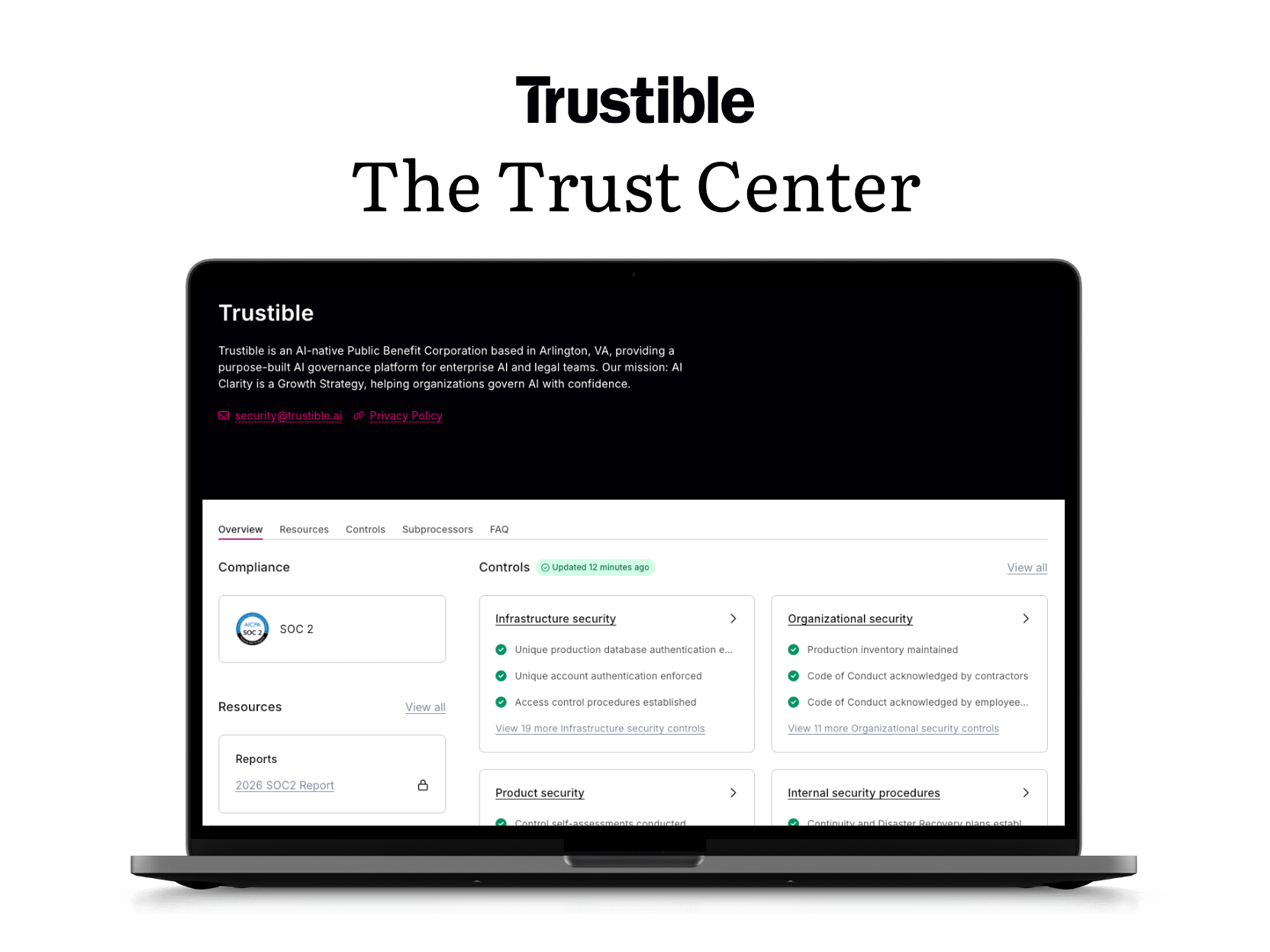
The Trustible Trust Center brings this documentation together in one place: a compliance status overview, the SOC 2 report available on request, a full breakdown of controls by category, a current subprocessor list, and an FAQ on data hosting and security.
If your team is running a vendor review on an AI tool right now, ask for this level of detail before you sign anything. Most AI vendors don’t have it ready. Visit the Trust Center.
4. Policy Updates
By: Sydney Cullen
Congress - The House spent $113,740 on AI tools last year, and $100,580 of it went to OpenAI, according to disbursement records reviewed by CNBC. Anthropic’s Claude got $13,160 across 37 transactions. Part of this is likely habit: ChatGPT was the first chatbot of its kind on the market and therefore was likely the first chatbot any staffers or members utilized. Usage since may have followed that early lead. OpenAI has also made significant Congressional financial contributions with spending $1.2 million on federal lobbying last quarter, a new record for the firm. Additionally, Sam Altman has personally donated over $126,000 to individual candidates since ChatGPT launched, alongside a $1 million gift to Trump’s 2024 inauguration fund.
Our Take: The offices writing AI legislation are forming their working model of “AI” from a single vendor’s defaults. Google, Anthropic, and Meta ship different tradeoffs on safety filtering, agentic autonomy, and content guardrails, and none of that shows up if hands-on experience starts and ends with ChatGPT. We couldn’t find a precedent for requiring broader exposure before regulating an industry. But AI may warrant one: what a model refuses to do and how it handles agentic tasks are exactly the questions pending legislation is trying to answer. Committees should treat time with competing frontier models as basic due diligence, not a nice-to-have.
California - AB 853, the California AI Transparency Act, took effect on August 2nd after being delayed from its original January 2026 start date. It requires generative AI systems with over a million monthly users to provide a free AI detection tool and embed provenance data in AI-generated image, video, and audio content. Starting in 2027, large online platforms will also need to detect standards-compliant provenance data attached to content, and capture device manufacturers will need to offer users a way to add disclosures to recorded content starting in 2028. The EU AI Act’s own Article 50 transparency obligations, which require labeling AI-generated content and disclosing chatbot interactions, took effect the same day.
Our Take: This is the least controversial move a legislature can make on AI. Nearly every state AI law passed in the last two years includes some version of this disclosure requirement. Treat AB 853 as a floor, not a milestone. The real compliance work is proving, not just claiming, that your organization can detect and label its own AI-generated outputs at scale. That pipeline needs to exist before enforcement action.
EU - EN 18286, the first harmonized standard developed specifically for the EU AI Act, is now available for organizations to purchase. It sets out quality management system requirements for high-risk AI providers under Article 17, covering risk management, lifecycle controls, post-market monitoring, and technical documentation. Once the European Commission cites it in the Official Journal, expected later this year, providers who can show conformity will get a presumption of compliance with Article 17. ISO 42001 already covers similar ground, but the AI Office noted in 2024 that it wasn’t fully aligned with the final AI Act text, which is why this standard was developed separately.
Our Take: Implementing EN 18286 isn’t required, but it’s the closest thing to a compliance blueprint an organization has for the Quality Management System, and an auditor working from it is checking a list the regulator effectively pre-approved rather than interpreting a general standard’s fit. High-risk providers should start gap-testing against it now. It’s also not required for grandfathered use cases, but any system undergoing a major update or modification loses that exemption, so a planned update is the right moment to check whether a system still qualifies.
—
As always, we welcome your feedback on content! Have suggestions? Drop us a line at newsletter@trustible.ai.
AI Responsibly,
- Trustible Team